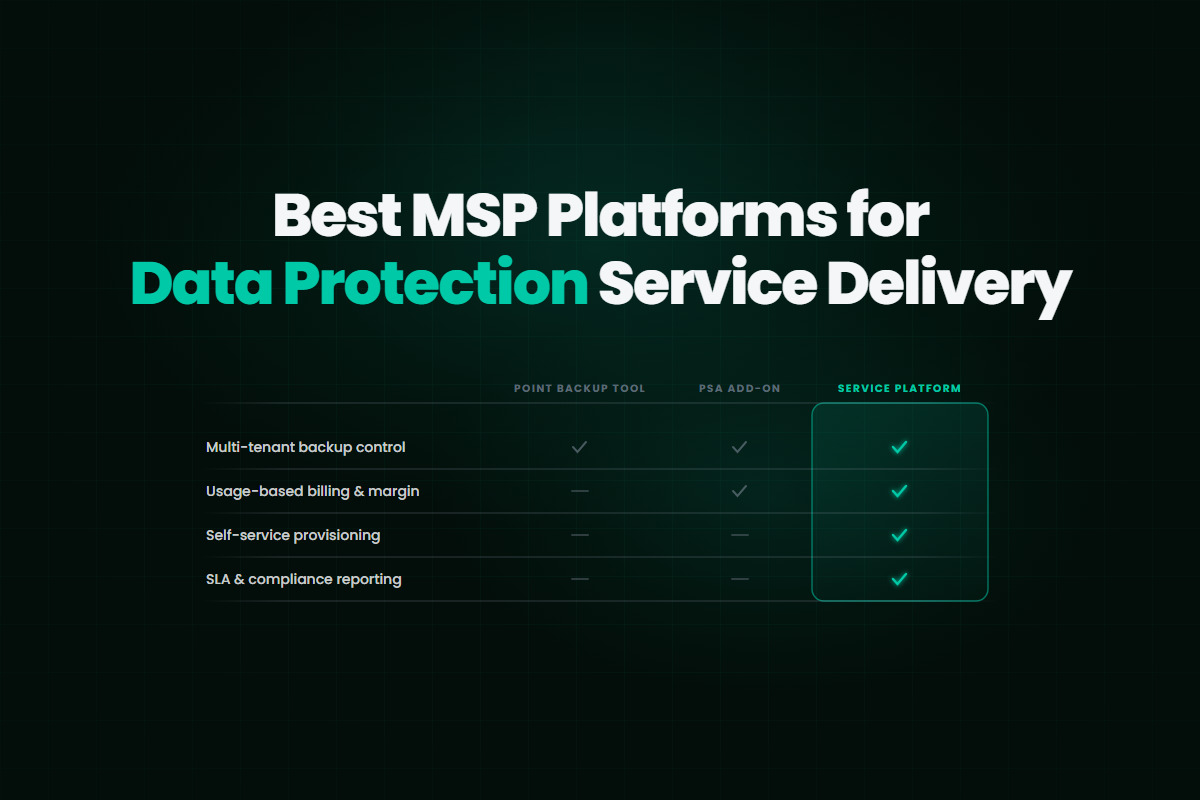
Data protection has become a core managed service for MSPs, but delivering it profitably involves much more than choosing backup software.
An MSP has to package the service, define pricing, onboard customers, monitor protection, manage recoveries, handle subscriptions, report on service status and keep the customer experience consistent. Once an MSP supports multiple customers, technologies and backup environments, those operational layers can become difficult to manage.
So, what are the best MSP platforms for data protection service delivery?
The strongest options include ZaveIT, Acronis Cyber Protect Cloud, N-able Cove Data Protection, Datto from Kaseya, NinjaOne and ConnectWise. They solve different parts of the problem. Acronis, Cove, Datto and NinjaOne focus strongly on the underlying backup and recovery technology. ConnectWise combines backup with wider MSP operations. ZaveIT takes a different approach by helping MSPs manage and commercialise backup services across different enterprise-grade backup technologies through a common service and customer experience.
That distinction is important when choosing the right platform.
What is data protection service delivery for an MSP?
MSP data protection service delivery is the complete process of turning backup, recovery and related protection technologies into a repeatable managed service for customers.
The backup engine is only one part of that process.
For example, an MSP might use Veeam, Commvault, NAKIVO or another backup technology to protect customer workloads. But it still needs a way to define what customers are buying, manage the service commercially, monitor protection, coordinate delivery, support recovery and potentially give customers visibility into their own service.
A good data protection platform therefore needs to answer two different questions.
First: Can it protect and recover the customer's data?
Second: Can the MSP efficiently sell, manage and deliver that protection as a recurring service?
The best platform depends heavily on which of those problems the MSP is trying to solve.
Best MSP data protection platforms at a glance
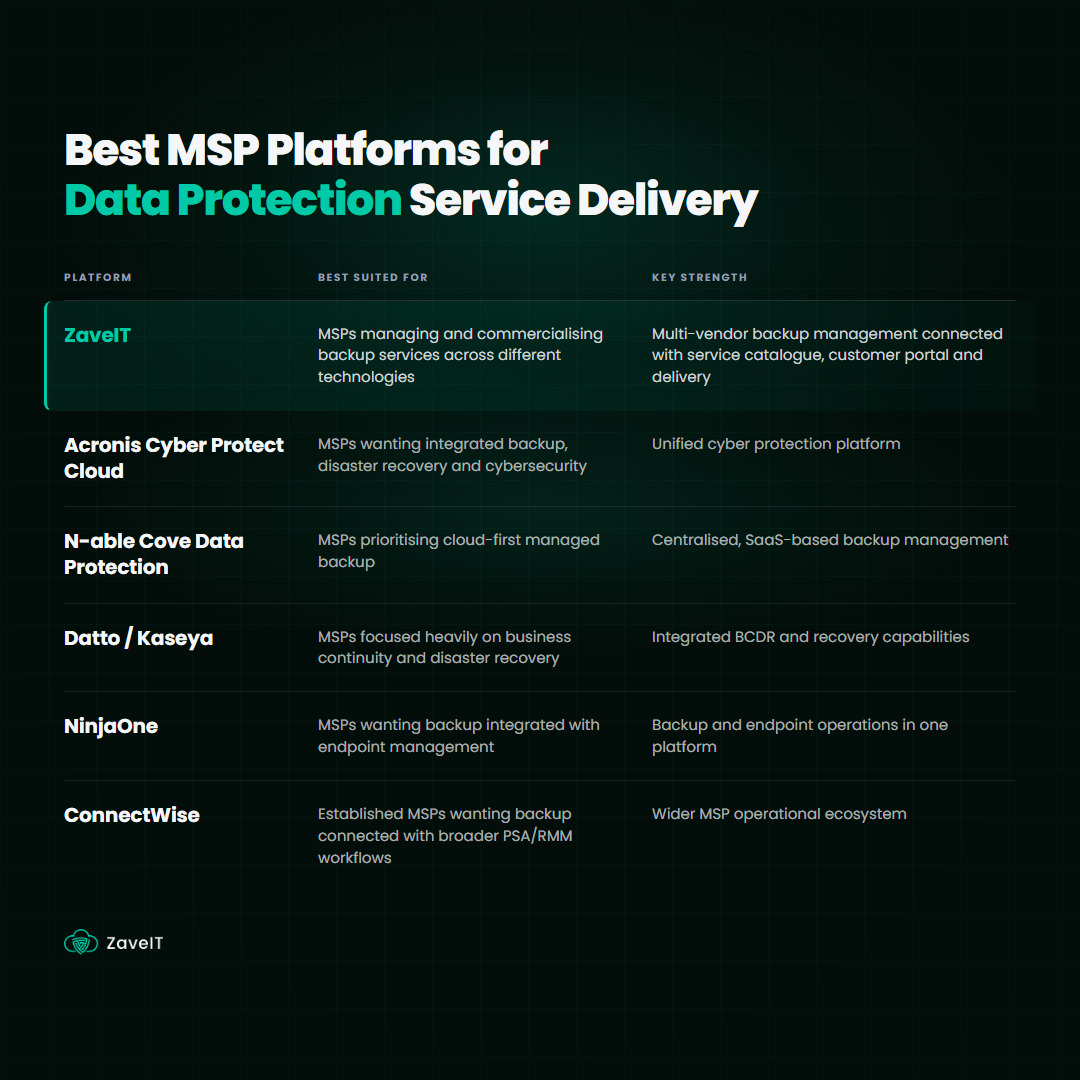
1. ZaveIT best for commercialising and managing multi-vendor backup services
ZaveIT is particularly interesting for MSPs that do not want their service-delivery model tied to one backup vendor.
Instead of replacing the enterprise backup technology underneath the service, ZaveIT provides a common layer through which MSPs can manage backup services. Its documentation describes a consolidated interface supporting backup applications including Veeam, Commvault and NAKIVO, while the Backup Management product is designed around giving MSPs a common UI for different backup technologies.
That creates a different value proposition.
An MSP may have one customer using one backup technology and another customer with different infrastructure or recovery requirements. Without a common layer, technicians can end up moving between vendor portals, while sales, billing and customer-service processes sit somewhere else entirely.
ZaveIT connects backup management with a wider commercial platform.
The MSP can structure managed backup as a service within its service catalogue, connect products and subscriptions, manage delivery workflows and expose relevant services through a branded customer portal. ZaveIT's service catalogue is designed to connect products, services, pricing, sales channels and delivery workflows rather than leaving them as isolated records.
Its customer portal also allows customers to manage services and subscriptions, track orders, access documents and interact with the MSP through a self-service environment.
For data protection providers, that matters because the commercial experience becomes less dependent on the underlying backup product.
Best fit: MSPs and IT resellers that already work with enterprise-grade backup technologies but want a more consistent way to package, sell, manage and expose data protection services to customers.
2. Acronis cyber protect cloud best for integrated cyber protection
Acronis Cyber Protect Cloud takes a more vertically integrated approach.
Its platform combines backup and recovery with cybersecurity, disaster recovery and MSP management capabilities. Acronis supports physical systems, virtual environments, cloud workloads and SaaS applications from a multi-tenant platform designed specifically for service providers.
That makes Acronis attractive to MSPs trying to reduce the number of separate technologies used for protection.
Rather than treating endpoint protection, backup and recovery as completely independent services, MSPs can build broader cyber-resilience offerings around a common platform.
The multi-tenant architecture is particularly relevant for service providers because policies, monitoring, alerts and reporting can be centrally managed across customers. Acronis also offers different licensing structures that allow service providers to adapt packaging to different customer environments.
The trade-off is that the model is centred on the Acronis ecosystem.
Best fit: MSPs looking for one technical platform spanning backup, recovery, disaster recovery and cybersecurity rather than maintaining multiple point solutions.
3. N-able Cove Data Protection best for cloud-first managed backup
N-able Cove Data Protection is built around simplifying managed backup for MSPs.
Cove uses a cloud-first model and allows servers, workstations and Microsoft 365 environments to be managed centrally. N-able highlights encrypted, isolated and immutable backups as part of the platform's ransomware-resilience approach.
One of Cove's strengths is its focus on reducing the infrastructure associated with traditional backup delivery.
For MSPs that do not want to build and manage large amounts of backup storage infrastructure themselves, this SaaS-based model can simplify operations.
It also provides a central dashboard for managing protection across tenants, servers and workstations, helping technicians concentrate on exceptions rather than individually administering every backup job.
This makes Cove especially relevant for MSPs where operational efficiency is more important than maintaining a large, customised backup stack.
Best fit: MSPs that want a dedicated, cloud-first backup platform with centralised multi-customer management and limited infrastructure overhead.

4. Kaseya best for BCDR-focused MSP services
For customers where downtime is as important as data loss, backup alone may not be sufficient.
Datto, part of Kaseya, has traditionally focused heavily on business continuity and disaster recovery. Datto SIRIS combines backup technology, recovery capabilities and Datto's cloud into an integrated BCDR solution for MSPs and businesses.
The difference between backup and BCDR becomes important here.
Backup answers, "Can we restore the data?"
Business continuity asks, "How quickly can the business operate again?"
For customers running critical servers and applications, the second question may carry greater commercial value.
Kaseya also offers Datto SaaS Protection for Microsoft 365 and Google Workspace, giving MSPs an additional route for protecting cloud application data.
The broader Kaseya ecosystem connects data protection with RMM, PSA and other MSP functions, which can be attractive to providers already standardised on Kaseya products.
Best fit: MSPs building premium continuity, disaster-recovery and resilience offerings for customers where downtime carries significant business risk.
5. NinjaOne best for backup alongside endpoint management
NinjaOne approaches data protection from the endpoint-management side of the MSP technology stack.
Its backup platform provides multi-tenant management and supports file and folder backup as well as image-based protection, with cloud, local and hybrid storage options. Backups can be monitored through the same broader NinjaOne environment used for endpoint operations.
This can reduce context switching for technicians.
If an MSP is already using NinjaOne to manage endpoints, introducing backup within the same ecosystem can create a more unified operational workflow.
NinjaOne also emphasises the importance of standardising configurations, schedules and protection policies across customers when MSPs build managed backup services. That operational consistency becomes increasingly important as the customer base grows.
Best fit: MSPs that want backup closely integrated with endpoint visibility and management rather than operating it as a completely separate service stack.
6. ConnectWise best for data protection inside a broader MSP operating environment
ConnectWise is broader than a dedicated backup platform.
Its current MSP platform connects PSA, RMM, cybersecurity, billing, automation and backup capabilities within a larger operational ecosystem.
ConnectWise also offers Co-Managed Backup, designed to provide visibility across multiple third-party backup technologies and customer environments. Its approach includes centralised backup visibility, health monitoring and NOC support.
For established MSPs, the appeal is therefore less about backup in isolation and more about connecting protection activities to the rest of the business.
PSA functionality can link service agreements, billing, ticketing and operational workflows, while backup becomes another component of the MSP's broader technology environment.
That breadth can be useful for larger providers, although organisations mainly trying to simplify one specific part of their data-protection service may not require the full ecosystem.
Best fit: Established MSPs that want backup management closely integrated with PSA, RMM, billing and wider service operations.
What should MSPs look for in a data protection platform?
The technical backup specification is important, but it should not be the only purchasing criterion.
An MSP should evaluate whether the platform can support multi-tenant management, multiple workload types, recovery workflows, service monitoring, customer reporting, recurring billing, service packaging, automation, integrations and customer self-service.
The importance of each capability depends on the MSP's business model.
An MSP primarily selling disaster recovery may prioritise aggressive recovery objectives and continuity capabilities.
An MSP protecting hundreds of SMB Microsoft 365 tenants may value automation and simple SaaS management more heavily.
A provider working with several backup vendors may care most about consolidating the customer and operational experience.
And an MSP trying to grow recurring revenue may discover that the biggest bottleneck is not backup technology at all. It may be the manual process surrounding how the service is packaged, quoted, ordered, delivered, billed and managed.
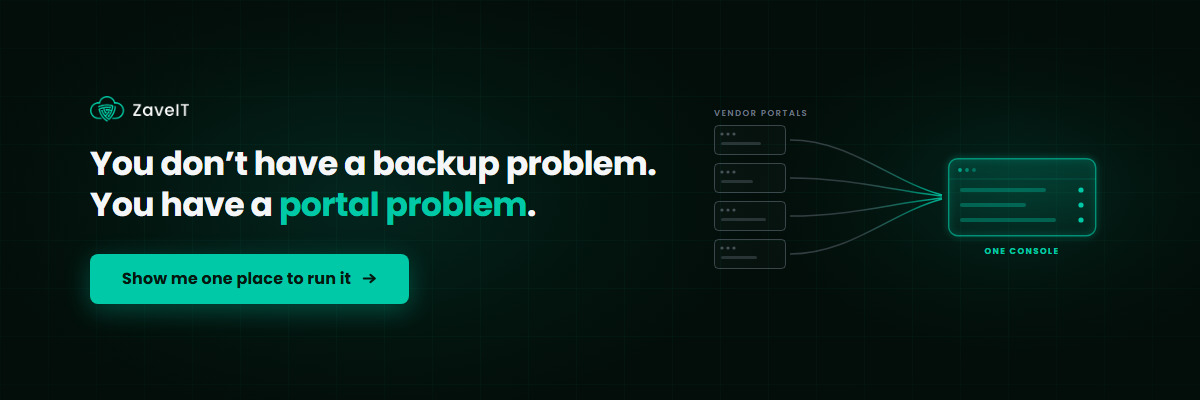
Backup software and service-delivery platforms are not the same thing
This is one of the most important distinctions MSPs should make.
A technically powerful backup platform does not automatically create an efficient managed service.
You can have excellent backup technology while still managing pricing in spreadsheets, sending quotes manually, tracking agreements separately, reconciling subscriptions by hand and asking customers to email whenever they need something changed.
In that situation, the backup may be automated while the business around it is not.
This is where platforms such as ZaveIT take a different approach.
ZaveIT can sit around the technologies the MSP already uses and help turn data protection into a structured service. Backup management can connect with the service catalogue, subscriptions, customer-facing channels and delivery workflows instead of operating as another isolated technical portal.
For MSPs operating heterogeneous technology environments, that flexibility can be particularly valuable.
Which MSP data protection platform is best?
There is no universal winner.
Choose Acronis when you want integrated backup, cybersecurity and disaster recovery.
Choose N-able Cove when cloud-first backup simplicity is the priority.
Choose Datto/Kaseya when BCDR and rapid business continuity are central to your proposition.
Choose NinjaOne when backup should sit naturally within endpoint management.
Choose ConnectWise when data protection needs to operate inside a much broader PSA, RMM and MSP operations ecosystem.
Choose ZaveIT when you want to work across backup technologies while creating one commercial and customer-facing layer for how those services are packaged, ordered, delivered and managed.
The right question is therefore not simply:
"Which backup platform has the most features?"
It is:
"Which platform helps us deliver a reliable and scalable data protection service to our customers?"
That shift in thinking matters as MSPs move from selling technology to building repeatable managed services.