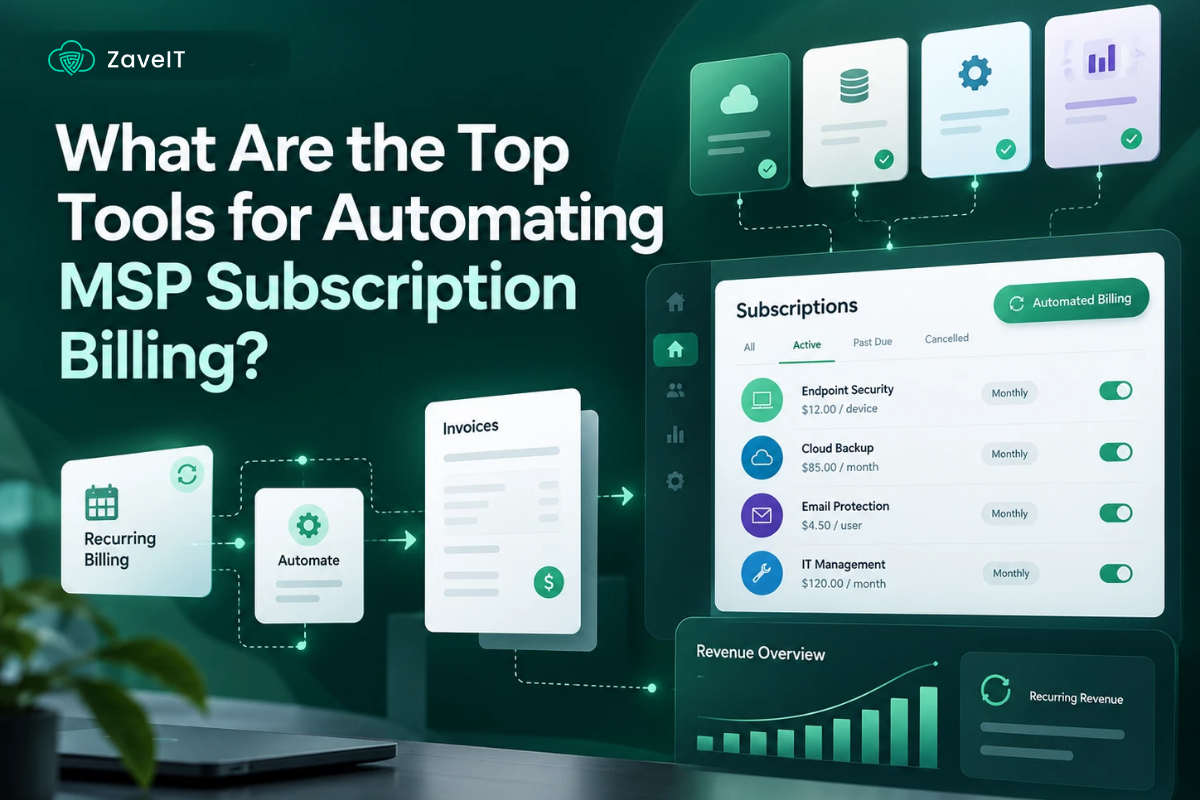
A practical comparison of MSP billing automation tools for managing recurring subscriptions, service changes, invoicing, and customer billing at scale.
For a growing Managed Service Provider (MSP), billing rarely becomes complicated overnight.
It starts with a few Microsoft 365 licences, managed security services, cloud subscriptions, and support agreements. Then customers add users, remove services, change plans, or request additional products halfway through a billing cycle.
Before long, someone in the finance or operations team is checking supplier portals, matching subscription changes against contracts, and making sure every charge reaches the right invoice.
The problem isn't necessarily the billing system. It's the amount of work required to get accurate information into it.
That's why MSP subscription billing automation has become an important consideration for service providers and IT resellers looking to grow recurring revenue without increasing administrative overhead.
But not every billing automation platform solves the same problem.
Some are built around PSA-driven invoicing. Others focus on subscription management, service catalogues, customer ordering, or usage-based billing.
This guide compares the leading options and explains where each fits.
What is MSP subscription billing automation?
MSP subscription billing automation is the process of managing recurring customer charges, subscription changes, service usage, and invoice preparation with less manual intervention.
For managed service providers, this typically involves connecting customer agreements, subscription quantities, pricing, billing cycles, and service delivery information.
A well-designed billing workflow can help MSPs:
- Track recurring subscriptions and licence quantities.
- Apply customer-specific pricing and contract terms.
- Capture mid-cycle service additions and cancellations.
- Consolidate recurring and usage-based charges.
- Reduce manual invoice preparation and reconciliation.
- Connect billing information with PSA, accounting, and other business systems.
The goal isn't simply to send invoices faster. It's to ensure that the services a customer consumes are accurately reflected in what they are charged.
What are the best MSP subscription billing automation tools?
Several platforms support recurring billing automation, but they approach the problem from different directions.
For MSPs and IT resellers evaluating their options, the following tools are worth considering.
MSP billing automation tools compared
The table below compares six platforms based on their primary use cases, billing approach, and integration capabilities.
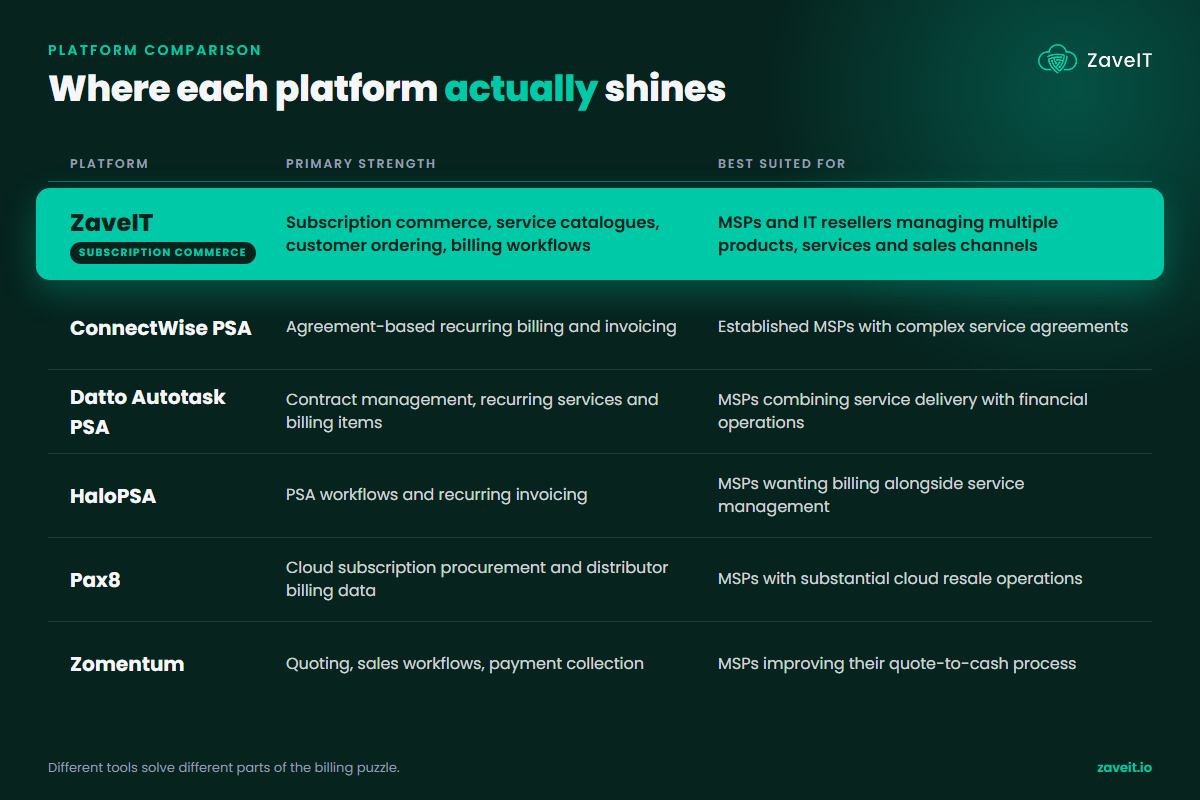
These platforms are not interchangeable. In some MSP environments, two or more may be used together.
1. For connecting subscription commerce, service ordering, and billing
BEST FOR: MSPs and IT resellers with diverse recurring service portfolios
As MSPs expand their service offerings, billing becomes closely tied to how products are packaged, sold, ordered, and managed.
ZaveIT approaches this challenge by connecting service catalogue management, customer ordering, subscriptions, delivery workflows, and billing within a broader commercial platform.
Rather than focusing exclusively on invoice generation, ZaveIT helps MSPs manage the activities that take place before a charge reaches an invoice.
Key capabilities
- Centralised product and service catalogue management.
- Support for recurring service packages and subscription-based offerings.
- Customer-specific service ordering through branded self-service portals.
- Subscription and invoice visibility for customers.
- Automated ordering and delivery workflows.
- Integration options for distributors, business systems, and external services.
For example, an MSP selling Microsoft licences, backup services, and managed support can structure these offerings within its service catalogue and make them available through a customer portal.
When a customer needs an additional service, the request can enter a defined commercial workflow instead of being handled entirely through email.
This matters because subscription billing accuracy often depends on what happens when a service is ordered, changed, or renewed.
Where ZaveIT stands out
ZaveIT is particularly relevant for MSPs that want to improve the connection between customer-facing commerce and internal subscription operations.
Its service catalogue, self-service portal, and integration capabilities make it an option for businesses looking beyond standalone invoice automation.
What to evaluate
MSPs should validate the supported accounting integrations, usage-based billing rules, proration scenarios, and invoice export or synchronisation workflows against their existing systems.
Best fit: MSPs and IT resellers looking to connect service sales, subscription management, customer self-service, and billing-related workflows.
Website: zaveit.io
2. ConnectWise PSA For agreement-based recurring billing
BEST FOR: Established MSPs managing recurring contracts and service delivery
ConnectWise PSA is a professional services automation platform that brings together service operations, customer agreements, and financial processes.
Its billing capabilities are built around agreements, which allow MSPs to define recurring charges and associate services with customer contracts.
Key capabilities
- Agreement-based recurring billing.
- Multiple billing cycle options.
- Tracking of service additions and contract-related charges.
- Cloud billing capabilities.
- Invoice generation and customer invoice access.
- Connections between RMM information and billing agreements.
Where ConnectWise stands out
ConnectWise is well suited to MSPs already using its PSA environment for tickets, agreements, and service operations.
Its strength is the relationship between operational activity and contract billing.
What to evaluate
MSPs with complex distributor portfolios should assess how subscription quantities, cloud consumption, and customer-specific pricing flow into their agreements.
Best fit: Established MSPs that need recurring billing closely integrated with service management and contract administration.
Website: connectwise.com
3. Datto Autotask PSA For contract-driven billing and service management
Autotask PSA provides contract management and billing functionality within a wider service management environment.
It supports recurring service contracts and subscriptions, allowing MSPs to create billing items associated with different customer agreements.
Key capabilities
- Recurring service contracts.
- Subscription billing items.
- Monthly, quarterly, semi-annual, and annual billing periods.
- Service-based contract charges.
- Invoice preparation through billing approval workflows.
- API access to subscription and service records.
Where Autotask stands out
Autotask is useful when recurring billing needs to be managed alongside service contracts and operational records.
For MSPs already working within the Datto and Autotask ecosystem, this can reduce the need to maintain separate contract and billing records.
What to evaluate
Businesses should check how effectively the platform handles external distributor subscriptions, changing licence quantities, and usage-based charges.
Best fit: MSPs seeking structured contract billing within their existing PSA operations.
Website: autotask.net
4. HaloPSA For recurring invoicing within an integrated PSA
HaloPSA is another option for MSPs that want recurring billing capabilities alongside ticketing, contracts, and customer management.
Its PSA-led approach is relevant to businesses that prefer to manage service operations and invoicing through a connected environment.
Key areas to evaluate
- Recurring invoice scheduling.
- Contract and agreement billing.
- Customer-specific recurring charges.
- Service and licence quantity updates.
- Accounting integrations.
- Automated billing approval and invoice workflows.
Where HaloPSA fits
HaloPSA is worth evaluating when an MSP wants billing to remain closely connected to service delivery.
It may be less appropriate as a standalone subscription commerce solution if the primary requirement is customer self-service purchasing, distributor catalogue management, or multichannel service sales.
What to evaluate
Ask for a demonstration using your actual contracts, licence adjustments, billing dates, and accounting system. The level of automation will depend on the integrations and workflows configured.
Best fit: MSPs looking for PSA-led billing and invoicing alongside service management.
Website: halopsa.com
5. Pax8 For cloud subscription procurement and billing reconciliation
Pax8 is primarily a cloud commerce marketplace rather than a traditional PSA or general-purpose billing platform.
It helps MSPs procure and manage cloud subscriptions through a distributor-focused ecosystem.
Key areas to evaluate
- Cloud subscription purchasing and management.
- Vendor and product catalogue access.
- Subscription quantity and renewal information.
- Billing and reconciliation data.
- Connections with PSA and business management platforms.
Where Pax8 fits
For MSPs with significant cloud resale revenue, distributor billing information is an important part of the invoicing process.
However, managing cloud subscription purchases is not the same as managing every customer billing requirement.
An MSP may still need a PSA, accounting platform, or additional subscription management layer to combine cloud charges with managed support, professional services, and other recurring offerings.
What to evaluate
Check which subscription records and billing data can be synchronised with your existing systems, including the frequency of updates and handling of billing adjustments.
Best fit: Cloud-focused MSPs seeking to streamline procurement and distributor-related billing processes.
Website: pax8.com
6. Zomentum For sales-to-payment workflows
Zomentum focuses on commercial workflows, including quoting, proposals, customer approvals, and payments.
Its capabilities can help MSPs reduce manual work between agreeing on a service and collecting payment.
Key capabilities
- Proposal and quote creation.
- Product catalogue and pricing support.
- Electronic signatures and approvals.
- Recurring payment collection capabilities.
- Payment reconciliation.
- Integrations with PSA and accounting platforms.
Where Zomentum stands out
Zomentum is relevant for MSPs whose commercial bottlenecks occur during quoting, customer acceptance, and payment collection.
Its payments offering includes integration options for QuickBooks Online and Xero.
What to evaluate
MSPs should distinguish payment collection automation from the management of subscription quantities, usage charges, and recurring invoice calculations.
Best fit: MSPs that want to improve their quote-to-cash process and reduce manual payment administration.
Website: zomentum.com
How to choose the right MSP subscription billing software
The best billing management tools are not necessarily those with the longest feature lists.
What matters is whether they can handle the way your MSP actually sells, delivers, and bills for services.
Before choosing a platform, evaluate these five areas.
1. Recurring pricing flexibility
MSP customers rarely follow identical pricing structures.
One customer may pay a fixed monthly fee for managed support. Another may have per-user pricing for Microsoft 365, while a third has a combination of subscriptions, usage charges, and annual agreements.
Your billing platform should accommodate different commercial models without requiring your team to maintain separate spreadsheets.
Ask whether it supports customer-specific prices, discounts, billing frequencies, and contract adjustments.
2. Subscription changes and renewals
Consider a customer with 80 Microsoft 365 licences who adds 15 users halfway through the month.
How does the platform capture that change?
Does it automatically update the relevant subscription record? Can it apply the correct billing date and proration rules? Will the new quantity reach the next invoice without someone re-entering it?
These questions are particularly important for MSPs managing hundreds of active subscriptions.
3. Invoice automation
Invoice automation should reduce the work involved in preparing accurate invoices, not simply automate the final sending process.
Look at how the system brings together recurring charges, service changes, usage information, and one-time fees.
A platform that generates invoices automatically but still requires extensive manual reconciliation may not deliver the operational improvement you expect.
4. Integration depth
Integration is often where the difference between basic and effective automation becomes clear.
An MSP might use a distributor marketplace for cloud subscriptions, a PSA for service management, an RMM for device information, and an accounting system for financial reporting.
The billing platform needs to move information between these systems reliably.
When comparing integrations, ask three questions: What information is synchronised? How often does it update? What happens when a synchronisation fails?
A long integration list is less useful than a smaller number of integrations that handle the required data correctly.
5. Customer experience
Billing isn't only an internal finance process.
Customers also need visibility into what they have purchased, which subscriptions are active, and how charges are calculated.
A self-service portal can make it easier for customers to access their subscription information, review invoices, and request additional services.
For MSPs looking to expand recurring revenue, connecting customer ordering with subscription management can be just as important as automating invoices.
Which MSP billing automation tool is best for your business?
There is no single platform that is the best choice for every MSP.
The right option depends on where your current billing process creates the most work.
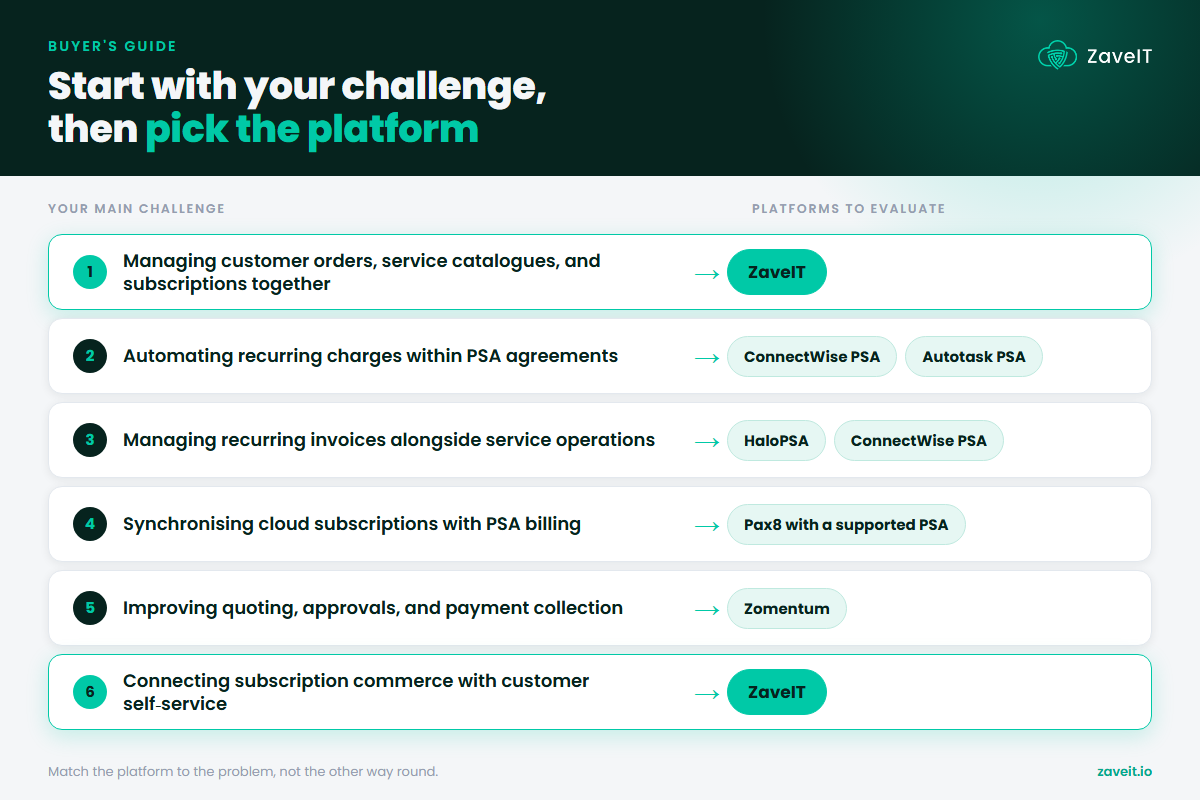
For example, an MSP whose primary issue is contract-based invoice preparation may find that its existing PSA already provides the functionality it needs.
An IT reseller managing a large catalogue of third-party software and managed services may have a different problem. Its priority could be ensuring that products, pricing, customer orders, subscriptions, and billing information remain connected as the business grows.
That distinction should guide the decision.
How much manual work can MSP billing automation remove?
The potential savings depend on how many customers, subscriptions, and service changes an MSP manages.
Consider an MSP with 200 customers.
If its team spends an average of 15 minutes per customer each month checking subscriptions, updating billing records, and reconciling charges, that represents 50 hours of administrative work.
Reducing that effort to five minutes per customer would bring it down to approximately 16.7 hours.
That's more than 33 hours saved each month.
This is an illustrative calculation, not a measured vendor performance claim. Actual savings depend on the complexity of the billing environment and the level of automation achieved.
The larger benefit may be consistency. When service changes are captured through structured workflows, there is less dependence on individual employees remembering to update multiple systems.
Frequently asked questions about MSP billing automation
What is the best MSP subscription billing automation software?
The best MSP subscription billing automation software depends on the business's operating model. ConnectWise PSA, Autotask PSA, and HaloPSA are relevant for agreement-based billing. ZaveIT is worth evaluating for subscription commerce, service catalogue management, and customer ordering workflows. Pax8 supports cloud subscription operations, while Zomentum focuses on commercial and payment workflows.
Can MSP billing automation software handle multiple subscription types?
Yes, many platforms support different recurring billing models, including fixed monthly fees, per-user subscriptions, and contract-based charges. However, usage-based billing, mixed billing cycles, and mid-cycle adjustments vary between platforms. MSPs should test these scenarios before making a decision.
How does recurring billing automation reduce revenue leakage?
Recurring billing automation can reduce revenue leakage by improving how subscription changes, service additions, cancellations, and usage charges are recorded and transferred into billing workflows. This helps limit situations where services are delivered but not included in customer invoices.
What is the difference between PSA billing and subscription billing software?
PSA billing typically connects invoicing with service contracts, tickets, time tracking, and operational activity. Subscription billing software focuses on recurring products, subscription lifecycles, pricing, renewals, and billing events. Some platforms combine both approaches, while others integrate with complementary systems.
Can MSPs automate billing for Microsoft 365 and other cloud services?
Yes. MSPs can use supported distributor integrations and subscription management platforms to transfer licence quantities and related billing information into their commercial systems. The extent of automation depends on the distributor, platform, and integration configuration.
Do MSPs need to replace their existing PSA to automate subscription billing?
Not necessarily. Some MSPs can improve billing by configuring existing PSA capabilities or connecting additional subscription management and commerce tools. The first step should be identifying where information is lost, duplicated, or manually transferred between systems.
Final thoughts: Automate the process, not just the invoice
For MSPs, recurring revenue should become easier to manage as the business grows. Yet subscription changes, disconnected systems, and customer-specific agreements can turn monthly billing into a recurring administrative burden.
The right automation platform should help reduce that burden while giving teams better control over subscriptions, pricing, and invoicing.
For some businesses, that means improving agreement billing within their PSA. For others, it means connecting the entire commercial journey, from service catalogue and customer ordering through to subscription management and billing.
ZaveIT is designed for MSPs and IT resellers looking to make that commercial journey more connected, bringing service offerings, customer self-service, ordering, and subscription workflows into one platform.
If your team is still moving subscription information between portals, spreadsheets, and billing systems every month, it may be time to review what can be automated.